
How to Search the Snohomish County Court Docket
Start with the Washington Courts Case Records Search when you are unsure which court holds the case. It spans Superior, District, and participating municipal court indexes. Choose the court level, pick the Snohomish court, then search by a full party name or a case number. What comes back is a statewide index. It is not the complete official record. For a Superior Court matter, the Washington Odyssey Portal adds case status, events, parties, and hearing filters. Opening filed documents can depend on registration, role, and fees.
A clean Snohomish County docket search starts with the court named on your notice, citation, or filing. Common names return many hits, so compare case type, filing year, and court. Copy case numbers exactly, punctuation and leading zeros included. Nothing coming back? Call that court's clerk. New entries can lag, restricted cases may not display, and older Snohomish County court records may need a clerk or archive request.
- Identify the court and case type.
- Open the statewide search or Odyssey for Superior Court.
- Search by case number first, or use the full party name.
- Compare the court, status, filings, and hearing entries.
- Ask the clerk for a document or certified copy when needed.
Snohomish Docket Portals Have Different Roles
The statewide index and Odyssey overlap, but they are not the same tool. Washington Courts reaches across the widest range of court levels. Odyssey digs into Superior Court case information. Find My Court Date answers one narrow question about a current setting. County calendars list whole sessions. Lean on a single system and you may miss what another one holds.
| Channel | Best use | Limit |
|---|---|---|
| Washington Courts search | Find the court and public case index | Not the full official record |
| Odyssey Portal | Review Superior case events and hearings | Some documents need added access |
| Find My Court Date | Check a current date | Settings can change |
| Clerk request | Obtain filed or certified material | Fees and processing time may apply |
The official Washington search screen displays court, name, number, type, and year fields.
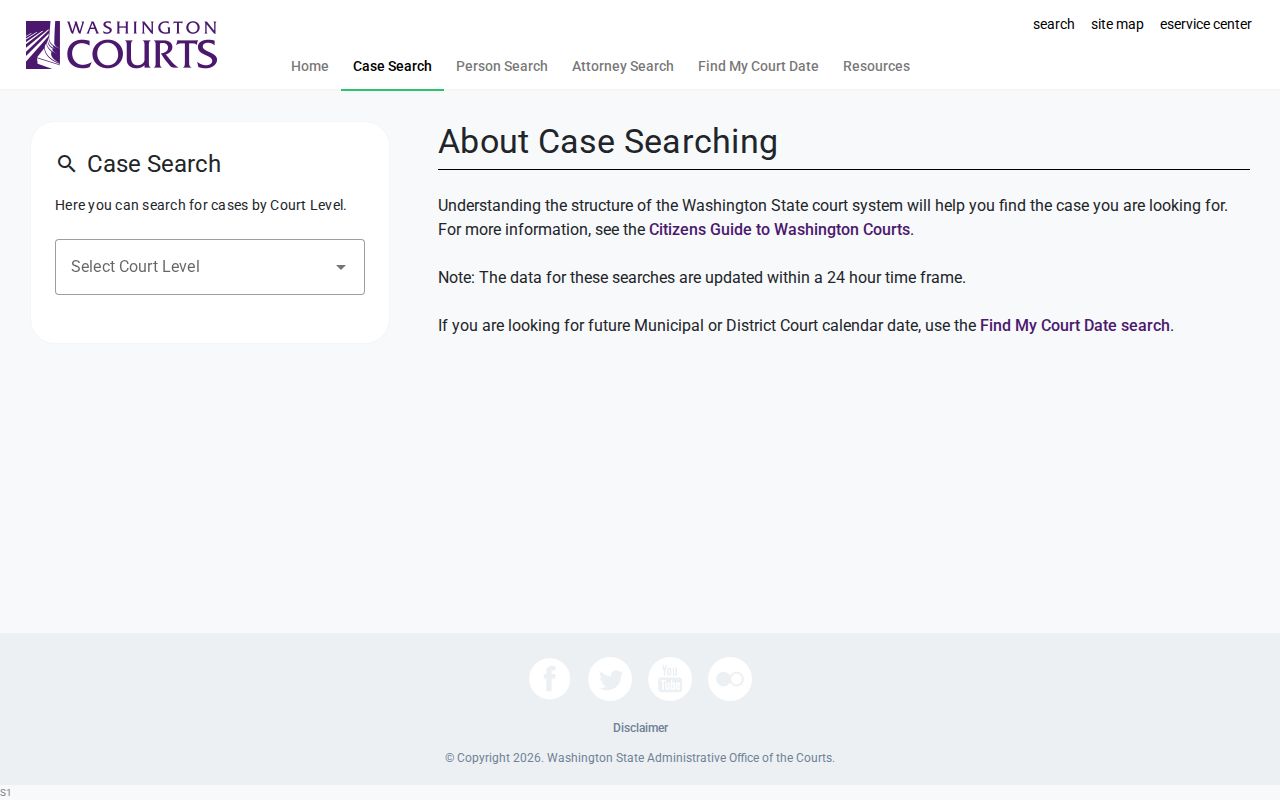
Those filters tame a common name, but each result still needs checking against the court's own file.
What a Snohomish County Court Docket Shows
A docket is the running history of a case. Where public, it names the case and the parties. The court, the filings, the settings, and the result entries appear there too. Online access does not reach every document, though. A line can record that an order was entered without ever showing the signed order. A calendar entry proves a setting landed on a schedule. It does not prove the hearing took place or stayed unchanged.
| Case number | The court identifier, year, case type, and sequence. |
|---|---|
| Parties | Public names and roles, subject to access rules. |
| Entries | Dated activity such as a complaint, motion, order, or judgment. |
| Settings | Date, time, location, officer, or event type. |
| Status | An open, closed, stayed, or other label needing context. |
| Disposition | The recorded outcome when available. |
Snohomish County has used several generations of case numbers. In Odyssey, county code 31 can appear where an older number carried a check digit. That pattern helps route a search. It proves nothing about jurisdiction or access.
Snohomish Court Systems Use Several Clocks
Conflicting results usually come down to update timing. The Washington index refreshes on its own cycle. Find My Court Date is billed as a real-time transaction tool, yet parts of the day can lag. Commissioner calendar files post on another cycle, municipal systems run separate processing windows, and a fresh filing may reach one view before another.
When two dates differ: check the newest docket entry, current court calendar, and clerk notice. Then confirm with the court that will hear the case.
A reset only means a setting moved. It does not dismiss the case. Sealed records, spelling differences, court mismatches, and conversion delays can all return nothing. Before assuming no Snohomish County court docket exists, try a second official channel.
Which Snohomish County Courts Keep Dockets
Jurisdiction decides where a docket lives. Snohomish County Superior Court handles felonies and major civil matters. Domestic cases, probate, juvenile matters, and lower-court appeals land there too. District Court hears infractions, small claims, and limited civil matters. It also handles the criminal cases within its authority. City misdemeanors, gross misdemeanors, traffic infractions, and local code cases belong to the municipal courts.
| Court | Typical docket | Route |
|---|---|---|
| Superior Court | Felony, larger civil, family, probate, juvenile | Odyssey, state index, County Clerk |
| District Court | Infraction, limited civil, small claims, lower criminal | State index and District Clerk |
| Municipal courts | City traffic, misdemeanor, code | City clerk and state tools |
| Federal court | Federal civil and criminal matters | PACER and Western District |
Federal cases never enter a county docket. Snohomish sits in the Seattle Division of the Western District of Washington.
Snohomish Court Records Come in Layers
A public index, a case image, a certified copy, and hearing audio each meet a different need. The index tells you a case exists. The State Digital Archives route holds selected Superior images and supports case number, keyword, date, and series searches. Certified copies come from the County Clerk. Audio follows its own request route.
The county's Digital Archives instructions show how to locate those selected images.
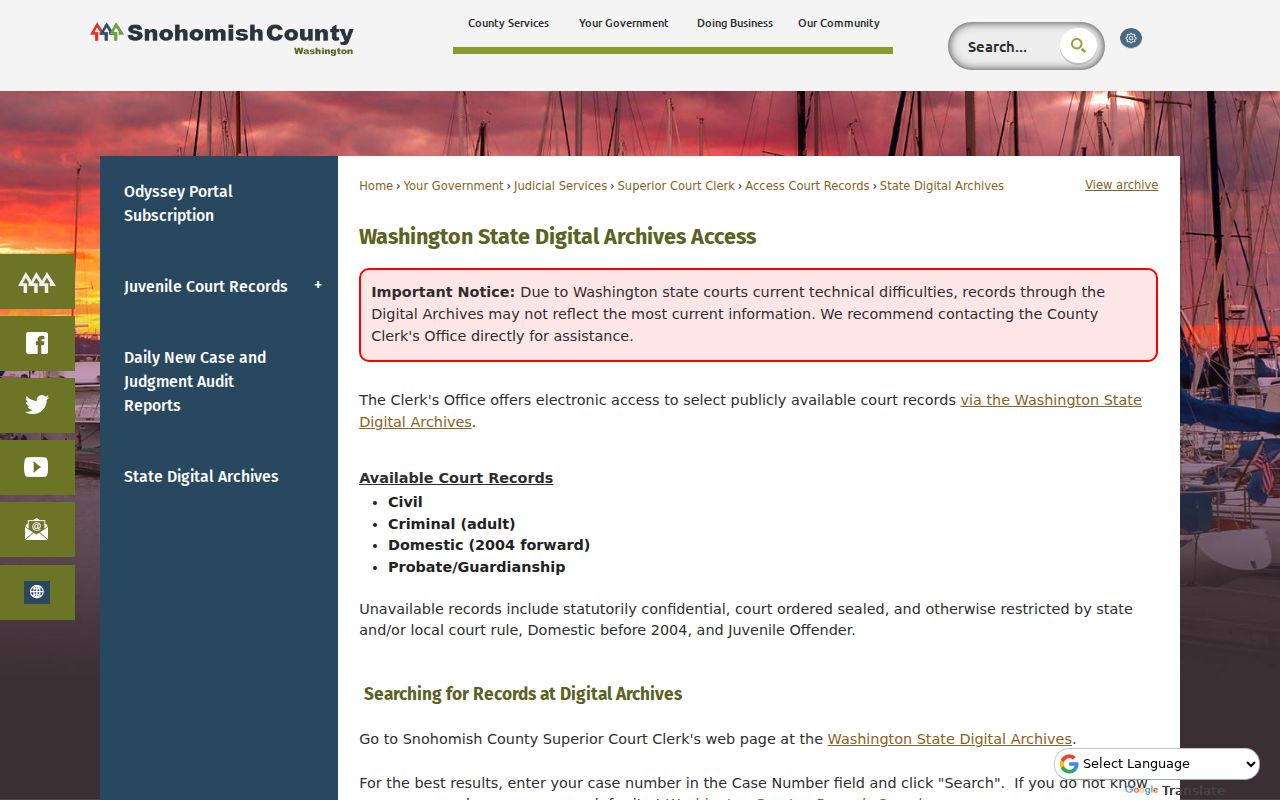
The archive serves historical research well, but it is not a complete copy of every Snohomish County docket.
- Docket
- The dated list of case activity.
- Filed document
- The item behind a docket entry.
- Certified copy
- A clerk-authenticated copy.
- Hearing audio
- A recording requested through the court's audio channel.
Finding Snohomish County Court Dates and Settings
Find My Court Date works for a party-and-court search. Use the Odyssey hearing search when you need Superior Court filters. For daily material, turn to the county's Calendars and Schedules page. Commissioner sessions post as separate downloadable files. Each is only a snapshot, so weigh the date against the latest notice.
The official interface shows the court and party fields used to find a setting. Try one field at a time.
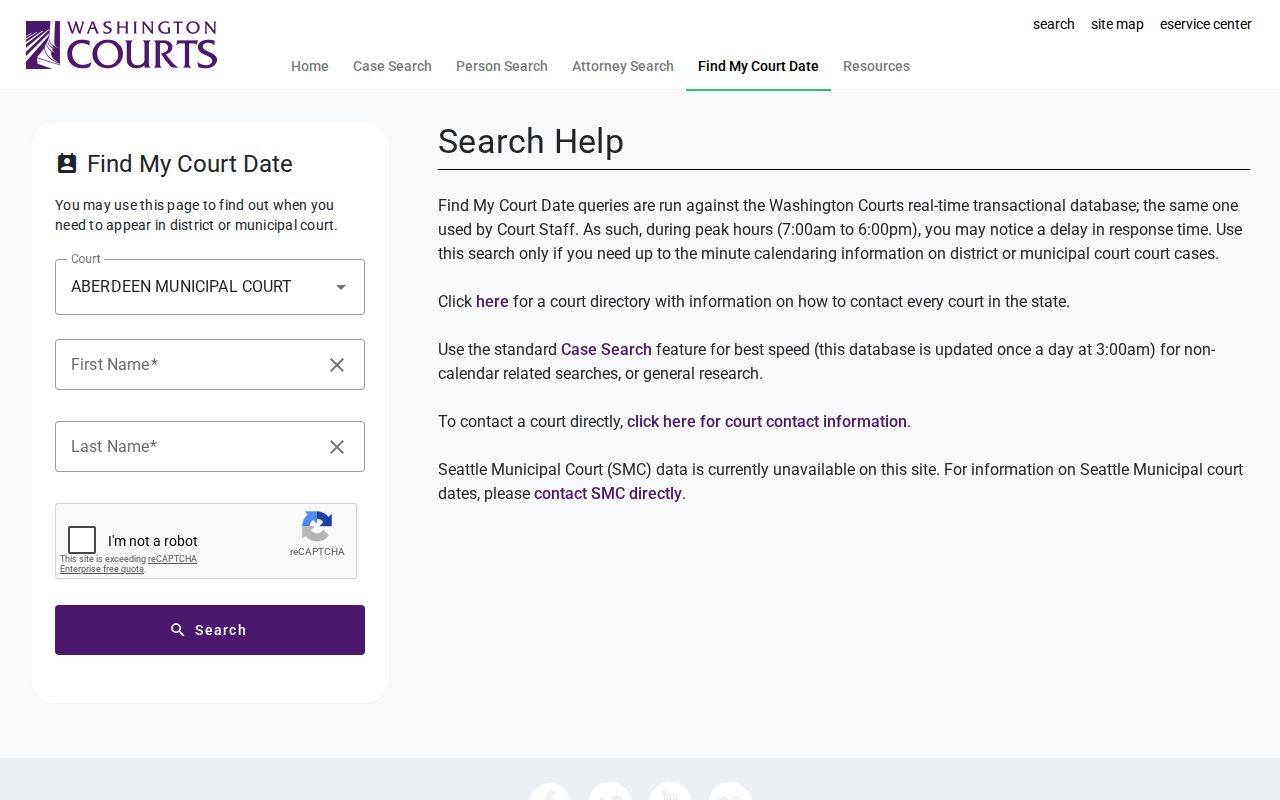
A row is a strong lead, never a substitute for a direct check when attendance matters. The Snohomish County court calendar page explains daily lists, confirmations, and resets.
Snohomish Dockets Face a 2026 Transition
District Court and the municipal courts announced a move to Enterprise Justice in September 2026. eFileWA and re:SearchWA are tied to that rollout. Notices described court-specific closures, payment pauses, and legacy windows. Treat those dates as useful history. After launch, a live court notice controls. One city's pause never bound every court.
To confirm which system the county division runs today, check the District Court notice. If a saved portal fails, go back to the court's current home page. eFileWA is a filing system, not a public docket search. A receipt also fails to show that a judge ruled.
The transition changes how you should describe a problem to court staff. Name the exact court. Give the date and time the search failed. Include the portal and any message on the screen. Keep the citation or case number in its original form. With that, the Snohomish County clerk can separate a conversion issue from an access restriction or a wrong-court search. It also keeps an old bookmark from being mistaken for the court's current public entry point.
Public Access to Snohomish County Court Dockets
Washington court case records fall under General Rule 31. That rule, not a county choice, controls what the public can see in a docket. Case files are a separate thing from county Public Records Act requests, though administrative records can still be sought under the Washington Public Records Act.
Key rules:
GR 31 sets the court-record access framework.
GR 15 governs sealing and redaction.
GR 22 limits access to sensitive family records.
Some Snohomish County records stay out of reach. Juvenile, sealed, and sensitive files may be missing or limited in what a docket search returns, so ask the clerk whether the trouble is the search itself, an access rule, or simply the wrong court.
When a Snohomish Docket Search Fails
Strip the extra filters and run the exact number again. Then try the party name with the expected court and year. Check the other likely court level too. Jurisdiction is not obvious from an address. A city police citation may belong to a municipal court. A county matter may sit in District or Superior Court. Bothell spans two counties, so a city name alone settles nothing.
- Check spelling and business-name format.
- Keep leading zeros and court codes.
- Look for a conversion notice.
- Use calendar tools for dates, not full files.
- Call the clerk shown on the source document.
Keep expectations modest. Older material may need research, restricted access can hide an index detail, and absence never proves a case does not exist. A name match proves identity no more than a blank screen proves nothing.
The Snohomish County Clerk and Docket Records
The Snohomish County Clerk holds Superior and juvenile files. Its Superior access page lays out Odyssey, the counter, mail, archives, historical research, and audio. District Court and each city clerk keep their own court records, and sending every request to the County Clerk can slow a docket search down.
The official Clerk page shows the routes for getting a Snohomish County court record.
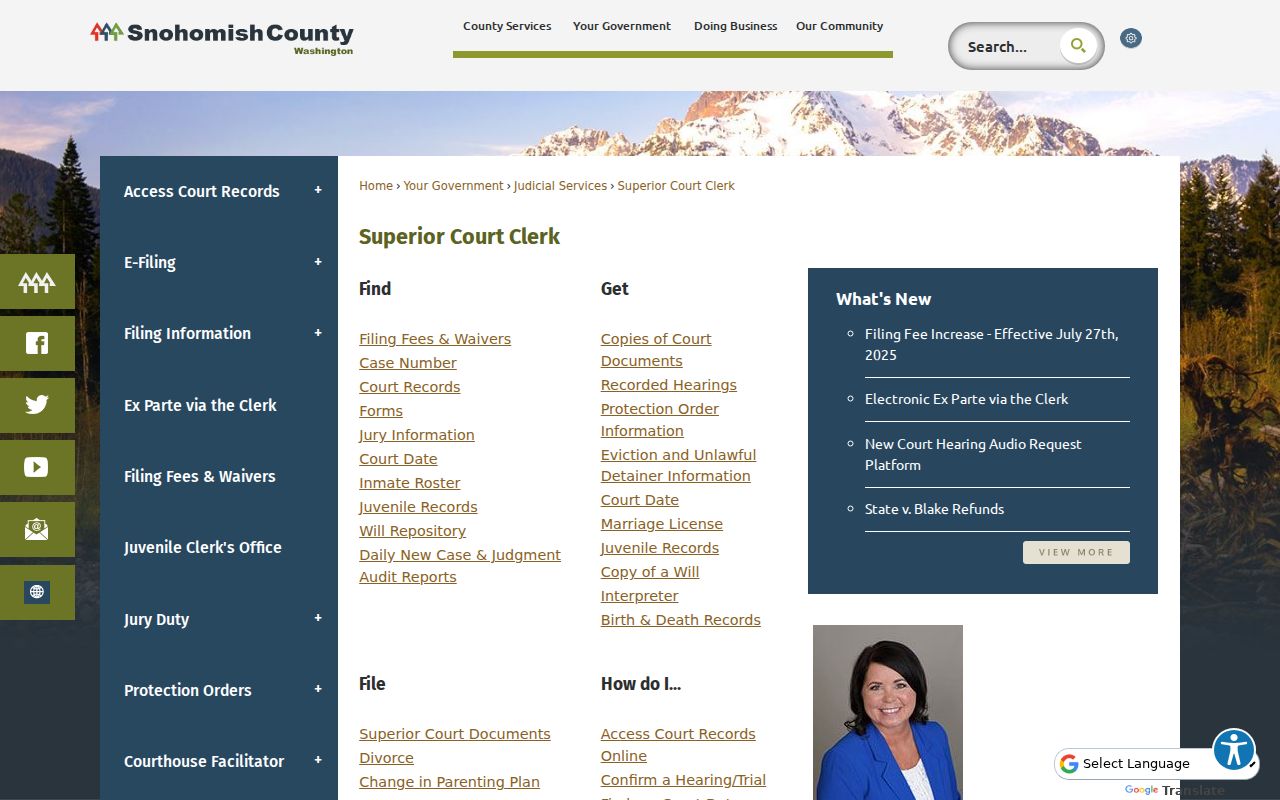
The service menu distinguishes quick online case information from copies supplied by the clerk.
Snohomish Specialty Calendars Need Context
Specialty calendars run beside the ordinary criminal and family dockets in Snohomish County. Adult Recovery, Family Recovery, District Mental Health, and similar settings use program names that can look cryptic in a short entry. The Adult Recovery Court page spells out current eligibility and schedule.
Program settings shift. Let the docket identify the case, then let the program page explain the setting. County reporting in 2024 marked the adult program's 25th year and counted more than 2,000 participants with 981 graduates. Those numbers record history. They do not measure today's caseload.
Process: case filing › referral › specialty settings › reviews › disposition.
Snohomish Court Copies and Fees
Copy costs depend on who holds the file and what you order. Superior Court sets separate rates for research, regular pages, certification, archive images, and audio. District Court posts its own fee schedule. Municipal courts vary. Say up front whether you want inspection, an ordinary copy, certification, or audio. Ask for an estimate.
| Request | Route |
|---|---|
| Superior document | County Clerk counter or mail |
| Old Superior file | Historical request or archives |
| District copy | District records request |
| Municipal file | Named city clerk |
| Recording | Court audio channel |
Inspection and delivery differ, and certification adds clerk authentication to the copies of a Snohomish County court docket you order.
Court Dockets by City in Snohomish County
Municipal courts hold the local dockets for misdemeanors, traffic infractions, and code cases. Felonies and larger civil matters go to county courts no matter where the events arose. An address alone will not identify the court.
Everett Court Docket
110,629 in 2020 · city criminal, infraction, and code cases
Marysville Court Docket
70,714 in 2020 · Marysville and Lake Stevens matters
Bothell Court Docket
48,161 in 2020 · a court serving a two-county city
Edmonds Court Docket
42,853 in 2020 · traffic, parking, photo, and criminal matters
Lynnwood Court Docket
38,568 in 2020 · municipal and traffic matters
The list below is ranked by population, not jurisdiction. Start with the court named on the citation or notice.
Snohomish City Dockets Follow Separate Routes
Every city clerk runs its own record and payment process. Everett and Marysville have each published separate transition dates and service notices. Bothell, Edmonds, and Lynnwood maintain distinct forms and contact paths. Start with the right city court. That keeps a municipal citation from landing at the Snohomish County Clerk by mistake. If the city court shows no match, move to District Court, then Superior Court, guided by the case type and the agency named on the original paper.
The differences run deeper than a portal link. Marysville hears matters for Marysville and Lake Stevens and posts an e-mail form for infraction hearings. Bothell serves a city straddling the Snohomish and King county line and publishes its own court-record fields. Edmonds splits court records away from general city public-record requests. Lynnwood keeps police citations, parking matters, and photo enforcement in separate lanes. Everett supplies municipal record, payment, and audio routes apart from the Snohomish County court docket. Let the notice or citation steer the first search. It names the court with custody of that record.
No paper in hand? Start with the agency that issued the citation. Also note the place where the event arose. Then ask the city clerk to confirm whether the matter entered its municipal docket. A clerk can also say whether the case moved, was refiled, or belongs at another level. Keep the full party name, an approximate filing date, and the citation or case number ready. With those details, Snohomish court staff can test the correct index instead of treating a broad name result as a confirmed match.
Map and Directions to the Snohomish County Courthouse
Superior Court files and the County Clerk's public counter are kept at the Snohomish County Courthouse, 3000 Rockefeller Avenue, in downtown Everett. The Clerk's office sits in the Mission Building on the courthouse campus, second floor, room M206, mail stop M/S 605. District Court administration uses the same address under M/S 508, and the county law library is nearby in room 0-051.
Snohomish County Clerk
3000 Rockefeller Avenue, M/S 605
Everett, WA 98201
425-388-3466
Monday through Friday, 8:30 a.m. to 4:30 p.m., closed noon to 12:45 p.m.
Plan around the midday counter closure, and note that Superior Court, District Court administration, and the law library share this courthouse address under different mail stops and room numbers. Juvenile Court files are kept separately at the Denney Juvenile Justice Center, 2801 10th Street, Everett. Calling the Clerk's line first confirms which counter has the record.